An Energy & Fuels paper examined cenospheres recovered after combustion of coal from the Ekibastuz Basin. It shows how particle size, phase composition and separation affect the concentrate. This is a review of one research material, not a specification for every Kazakh cenosphere or for Spheron products.
What did the researchers actually study?
Elena V. Fomenko and colleagues analysed a cenosphere concentrate produced during industrial combustion of Ekibastuz coal. The coal came from Kazakhstan, while the ash and concentrate were linked to specific combustion and recovery conditions.
That distinction matters. The name of the basin identifies the coal source, but it does not replace information about the boiler, temperature, ash collection, purification or batch control.
From raw concentrate to controlled fractions
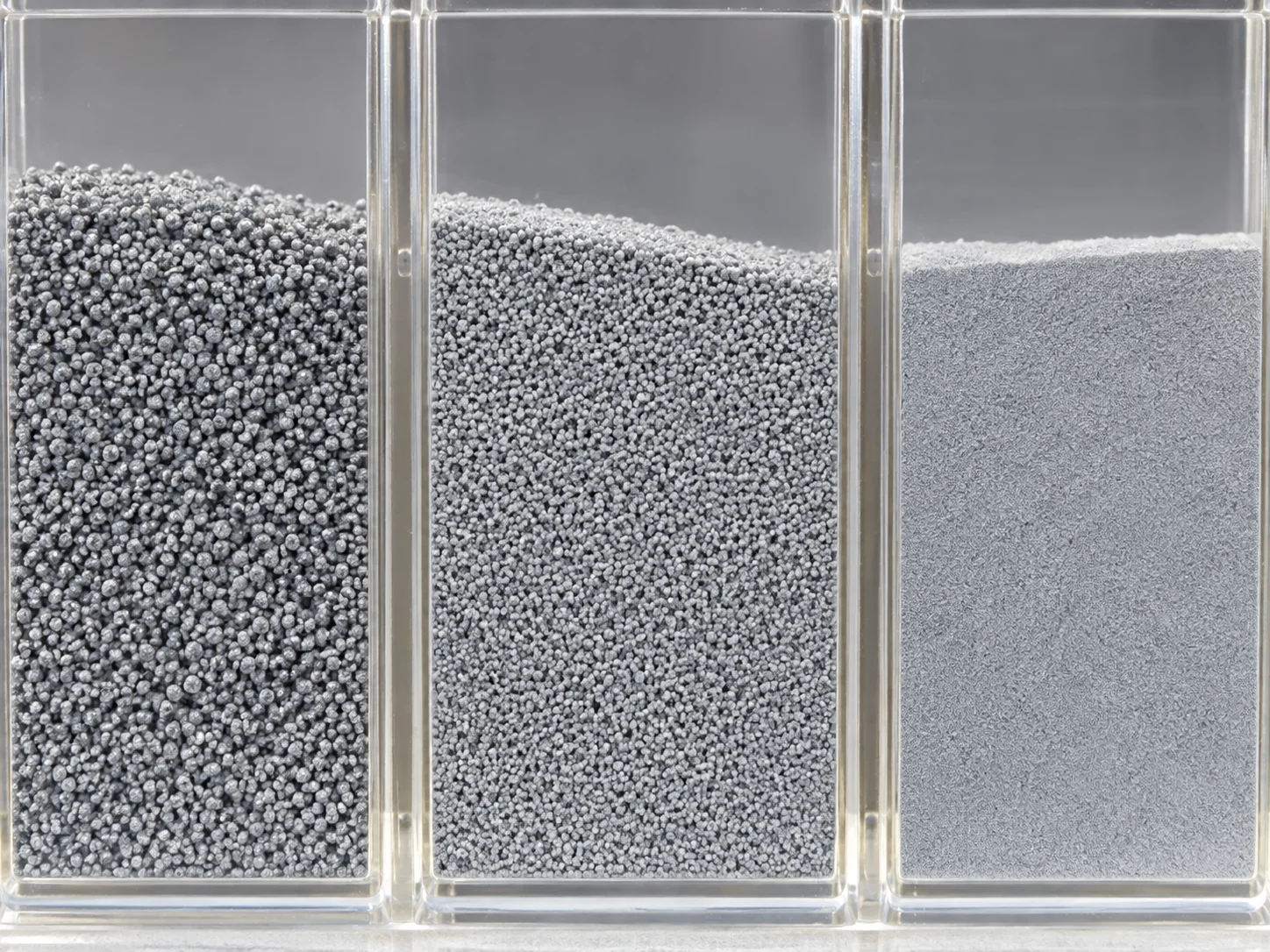
The raw concentrate was separated magnetically, by sieving and hydrostatically. This allowed the researchers to remove iron-richer particles, create narrow size classes and reject broken or perforated globules that filled with water after evacuation.
The raw concentrate had d₁₀ = 40 µm, d₅₀ = 111 µm, d₉₀ = 209 µm and d₉₉ = 282 µm. These values show why a complete particle-size distribution is more informative than a nominal sieve range alone.
Key numerical results
The narrow, non-magnetic and non-perforated fractions had low bulk density. As particle size increased, Al₂O₃ and mullite increased while the glass phase decreased. These are ranges for the tested fractions, not commercial guarantee limits.
| Parameter | Result in the study | Practical relevance |
|---|---|---|
| Bulk density | 0.40–0.45 g/cm³ | Relevant to dosing, logistics and volume conversion |
| Al₂O₃ | 33–38 wt% | Content increased with particle size in the tested fractions |
| Fe₂O₃ | 0.9–1.8 wt% | Range after magnetic separation |
| Glass phase | 57–73 wt% | Its share decreased in larger fractions |
| Mullite | 25–40 wt% | Its share increased in larger fractions |
| Quartz | 1.2–2.5 wt% | A crystalline component in the tested fractions |
Particle size changed more than the sieve class
Smaller fractions containing about 33–34 wt% Al₂O₃ were dominated by regular spherical globules. Larger fractions more often contained complex porous particles with network or foam-like morphology. The authors associated increasing Al₂O₃ with larger cenospheres and more porous shells.
For formulation work, two materials with a similar median diameter may therefore behave differently. Shell integrity, morphology, broken-particle content and phase composition matter alongside particle size.
Why separation matters as much as origin
The study demonstrates how processing can organise material properties. Magnetic separation reduces iron-rich fractions, sieving narrows particle size, and hydrostatic separation helps reject leaking and broken particles.
- Paints and coatings: size control and dark impurities affect finish, colour and application stability.
- Mortars and lightweight concrete: bulk density, shell strength and intact-particle content affect dosing and composite density.
- Refractory materials: aluminosilicate chemistry, crystalline phases and behaviour at the target temperature are relevant.
- Polymer composites: size, morphology and shear resistance govern whether hollow particles survive processing.
How to compare cenosphere offers
Labels such as “Chinese”, “Kazakh” or “from Ekibastuz coal” are not enough to select a grade. This paper concerns one process stream and shows how strongly the result depends on classification and purification.
- Particle-size distribution: request d₁₀, d₅₀ and d₉₀ or a full curve, not only a nominal fraction.
- Density: distinguish bulk from true density and check the measurement method.
- Particle integrity: ask about floating, sinking, perforated and broken particles.
- Batch chemistry: compare SiO₂, Al₂O₃, Fe₂O₃ and loss on ignition on a current certificate of analysis.
- Validation: make the final decision after a trial in the actual formulation and process.
Conclusion: origin starts a specification; it does not complete it
The Ekibastuz study describes a low-bulk-density, aluminosilicate-rich material with variable morphology. Its broader lesson for buyers is that performance reflects the combined effect of ash source, combustion conditions, size fraction and separation process.
At Spheron, selection starts with the application requirements, moves to data for a specific fraction and ends with a practical trial. Research helps buyers ask better questions, but it does not replace a product specification or a current batch certificate.
Frequently asked questions
Were the studied cenospheres produced in Kazakhstan?
They were formed from Kazakh coal from the Ekibastuz Basin under specific industrial conditions. The results should not automatically be assigned to every producer in Kazakhstan.
Does a bulk density of 0.40–0.45 g/cm³ always mean a better material?
No. Low density can be useful, but shell strength, particle size, chemistry and behaviour in the actual process also determine suitability.
What does high Al₂O₃ content indicate?
In this study, higher Al₂O₃ was associated with larger particles, more mullite and more porous morphology. It is not a stand-alone measure of quality.
Are these results a specification for Spheron products?
No. This is an independent review of a scientific publication. Commercial parameters must be checked in the relevant product data and batch certificate.
How should cenospheres from different suppliers be compared?
Compare particle-size distribution, bulk and true density, chemistry, damaged-particle content and batch documents, then run an application trial.