
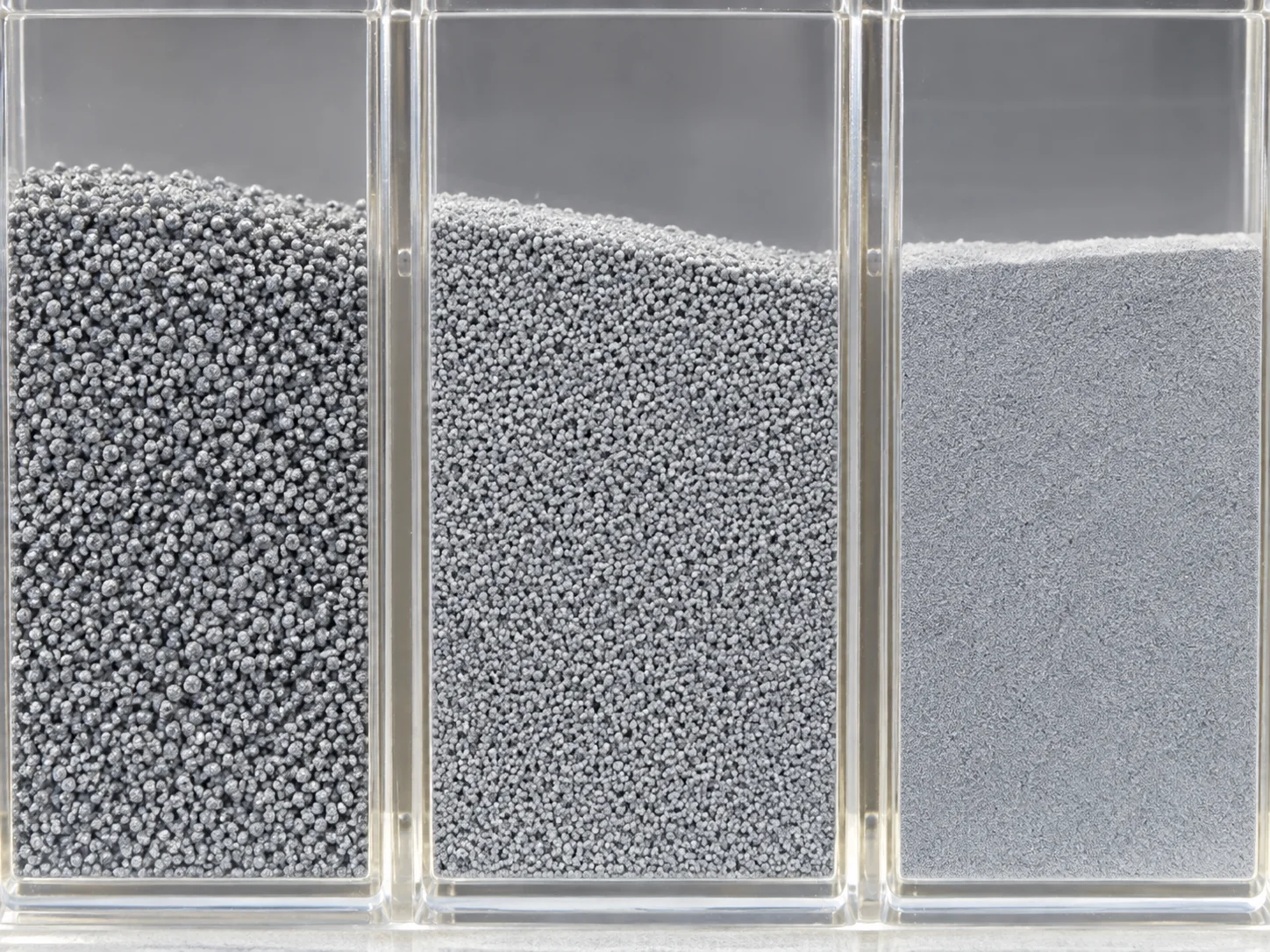
Bulk density describes material loosely arranged in a container, while true density relates to the volume of the particles themselves. Both values are needed, but they answer different processing questions.
Bulk density supports logistics and dosing decisions
Bulk density includes the voids between particles. It matters when sizing silos, bags, hoppers and feeding equipment, and when converting weight-based dosing into volume-based dosing.
Filling method, compaction, moisture and particle-size distribution can all affect the result. Comparisons should therefore use the same measurement method.
True density describes weight-reduction potential
True density is closer to what matters once particles are incorporated into a matrix. It helps estimate how the density of a composite, coating or mortar may change when part of a heavier mineral filler is replaced with lightweight microspheres.
The lowest value is not automatically the best option. Particle resistance to processing, viscosity, mechanical requirements and the target material structure must also be considered.
Why a weight-for-weight comparison can mislead
One kilogram of lightweight microspheres occupies far more volume than one kilogram of a conventional mineral filler. A 1:1 replacement by weight can therefore change volume loading, viscosity and binder demand dramatically.
- start with volume-based calculations;
- measure fresh and cured formulation density;
- record mixing method and air entrainment;
- compare mechanical properties using identical specimen geometry.
The practical conclusion
Bulk density primarily indicates how a material will store and feed. True density helps predict its effect on the finished formulation. Only a combined review provides a useful product picture.