
Selecting a cenosphere supplier starts with the requirements of your formulation. This guide explains which specifications to compare, how to plan a useful trial and what to include in a delivery enquiry.
Start with the requirements of your formulation
When choosing a cenosphere supplier, begin by describing the application. A coating, a dry construction mix and a polymer composite each have their own formulation and production requirements. Prepare a short outline of your dosing and mixing process, together with the properties you need to assess in the finished product. This gives the supplier a clear starting point for discussing suitable products.
For SPHERON aluminosilicate hollow microspheres, the technical datasheet is the basis for comparison. It lists the product code, particle fraction, bulk density, true density, moisture, sinkers, colour and pH. Identify the limits already defined in your specification and the characteristics you intend to evaluate during trials.
Compare the particle fraction and the exact product code
SPHERON products cover different particle-size ranges. The datasheet for SPH-150E lists 0–150 µm, while SPH-300A lists 0–300 µm and SPH-500E lists 0–500 µm. When reviewing quotations, keep each specification attached to its exact product code.
If the proportions of smaller and larger particles matter to your process, also review the particle-size distribution table. Include your size requirements in the enquiry, or identify the material against which you want to compare a sample. Our guide to selecting a microsphere fraction explains this step in more detail.
Read the density and quality parameters together
Put the candidate products into a comparison sheet using the same units. The SPH-150E datasheet gives a bulk density of 0.36–0.44 g/cm³, a true density of 0.78–0.88 g/cm³ and a sinkers value below 10%. For SPH-300A, the corresponding values are 0.36–0.42 g/cm³, 0.75–0.85 g/cm³ and below 5%.
The datasheets identify the sinkers test as the Imhoff cone method. Both of these documents list moisture by mass at no more than 0.5% and a pH range of 7.0–9.9. They also describe different colours: light grey to grey for SPH-150E and white to light grey for SPH-300A. Include these differences when deciding which products to test in your formulation.
Keep bulk density and true density in separate columns rather than combining them into a single density figure. See bulk density versus true density of microspheres for further explanation of these parameters.
Plan a trial that produces comparable results
Choose one or two products that meet your initial requirements and agree on a common trial plan. Record the addition level, dosing method, order of ingredient addition, mixing time and assessment conditions. Keep the sample identification with the results so that the observations can be traced to the material tested.
Assess the characteristics relevant to your product, such as behaviour during mixing, surface appearance or a measurement defined in your internal procedure. Compare the results with a reference formulation. Teams developing coatings can also consult our article on microspheres in paints and coatings when planning the evaluation.
Agree on documentation, packaging and delivery
Before placing an order, check the technical datasheet for the selected product and agree on the documents required with the shipment. Include any requirements for product and batch identification in your enquiry. Clear identification helps the receiving team record the material correctly and retrieve the relevant information when it is used in production.
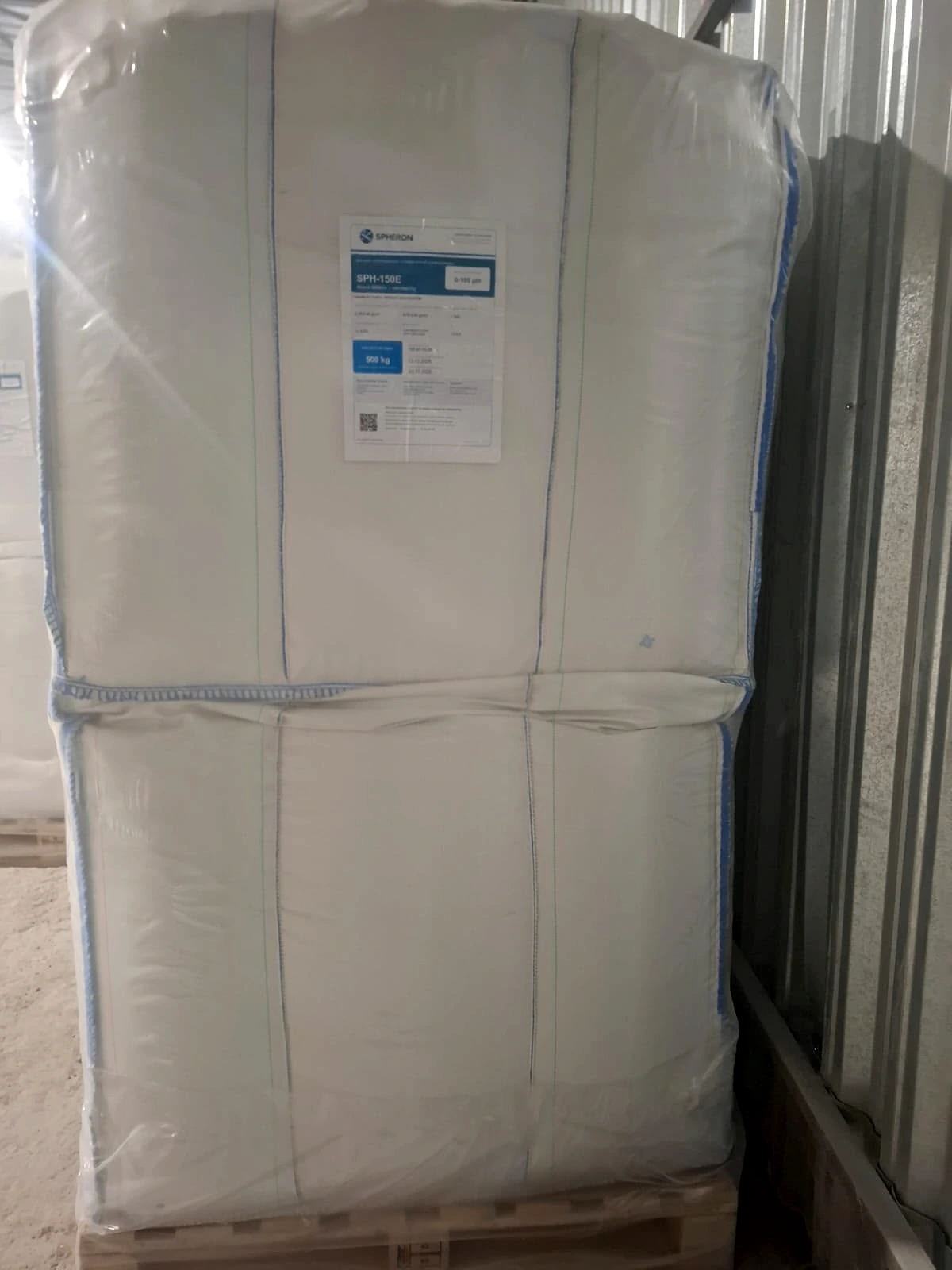
The SPH-150E, SPH-300A and SPH-500E datasheets list 20 kg paper bags, 20 kg water-soluble bags and 500 kg big bags on pallets. State your preferred packaging, required quantity and delivery location. Discuss unloading arrangements, delivery terms and the requested date with the supplier.
For a direct comparison, use the SPH-150E datasheet, SPH-300A datasheet and SPH-500E datasheet.
What to include in an enquiry to SPHERON
Describe the application, particle-size requirements, important specification limits and planned quantity. Add the preferred packaging, delivery location and requested date. If the enquiry concerns material for trials, mention that as well. Contact SPHERON to discuss product selection and delivery arrangements.
Frequently asked questions
Where should I start when selecting a cenosphere supplier?
Start with your formulation requirements and the datasheets for specific products. Then plan a trial with clear assessment criteria.
Can products with similar particle fractions have different specifications?
Yes. Compare density, sinkers, moisture, colour and pH separately. Check the datasheet for the exact product you are considering.
What information is needed for a delivery enquiry?
Provide the application or product code, quantity, preferred packaging, delivery location and requested date, along with any documentation requirements.